
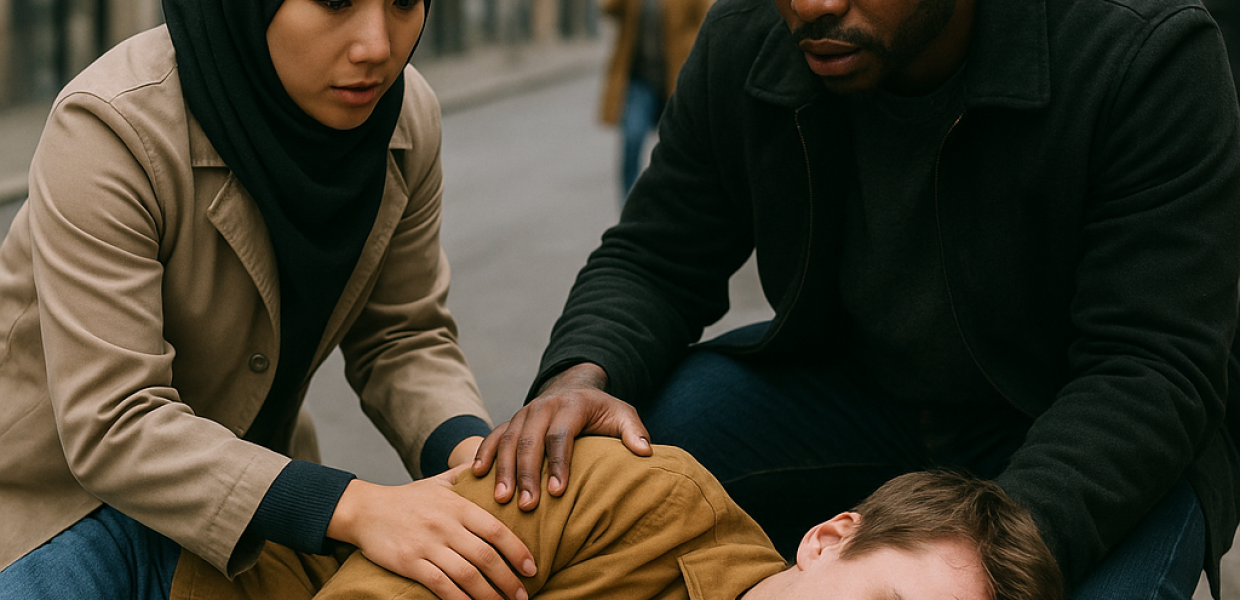
The scenario in this post is based on a real tragedy. In a busy Tesco store a customer suffered seizures, then a cardiac arrest. People gathered. Staff called 999. Unfortunately, the first minute was empty.
No one checked for breathing or a pulse. No cardiopulmonary resuscitation (CPR). No automated external defibrillator (AED) brought to revive or sustain them. No one knew how to put them in the recovery position. They subsequently died.
Consequently, the coroner later issued a Prevention of Future Deaths report. Its message was plain. People cared. But the gap between caring and acting can be fatal.
Safe Spaces For All CIC exists to help bridge such gaps. It seeks to create a zero-responder environment. An environment where all those present; staff and customers can make sure the first minute is not empty.
Despite there being many customers around no one acted.
What follows is the story of how we fill that first minute, and why it matters for every shop, venue, school, street, and publicly accessible place in the country.
It begins the way these moments often do. A normal day. A trolley that will not steer straight. A shopping list on a phone. Then a shape on the floor and the sudden hush that follows. People look. They care. They do not know what to do. Someone speaks to the person. Someone calls for the manager. Someone reaches for a bottle of water because that is what people do when they feel helpless.
The first minute decides the shape of everything that follows. It decides how long the brain goes without oxygen. It shapes what the ambulance call handler can advise. It sets whether the story that follows is about dignity and effort or about silence and regret. In many places that minute is empty. Not because people do not want to help, but because our legal system quietly rewards hesitation. It feels safer to wait. Safer to escalate. Safer to stand back and hope.
We have taught people to fear the law more than they fear doing nothing. We have told them that someone else will arrive who knows more. We have built a hierarchy that was never designed for the first minute of a medical emergency. So, the minute passes. Then the second. The person on the ground drifts further away. The bystanders carry that minute with them for a very long time.
Safe Spaces for All offers a different perspective. It does not claim certainty. It does not expect to turn shops and venues into clinics. It seeks to give confidence for anyone to fill the first minute.
In this scenario, a Safe Space the day starts with a short brief. There is a first aider of the day. Everyone knows who that is and where they are. The nearest AED is clearly signposted and accessible, with a small grab bag and Bleed Kit beside it.
The manager and supervisor have a simple card that mirrors the questions the 999-call handler will ask. Staff have regularly practised two turns of compressions, so the rhythm feels familiar; not a memory from a classroom last year but a familiar habit.
When a person falls, someone nearby checks for a response and for normal breathing. If it is not there, they clear the airway and begin compressions. They ask someone to call a 1st-aider and AED to their location.
The phone goes on speaker. Another colleague brings the AED and opens the bag. The manager clears space and gets someone ready to meet the EMT at the door.
Customers are spoken to with calm words. Privacy is kept with simple respect, without fuss. The team change over every two minutes so compressions stay strong. The AED speaks and they follow it. (Note: If the person revives, they are placed in the recovery position.)
The ambulance crew arrives to a scene that is under control. They hear the times. They see the pads in place. They see faces that look tired but steady. They take over and do what only they can do. Whatever the clinical outcome, the person receives timely care. Their family will learn that strangers acted with skill and kindness when it mattered.
This is what changes when we treat first aid as a basic civic skill. It shortens the time without circulation. It gives better information to the call handler. It protects dignity in public places. It reduces the shock that staff carry when they wanted to help but did not know how. It gives organisations a fair and defensible standard. Reasonable, not limitless.
Safe Spaces for All rests on a simple idea. Zero responders are not a special team. They are all of us. We start early. Children learn the basics in primary school. They grow in confidence through secondary school. Workplaces refresh skills in short, regular drills. Sports clubs and community groups keep the knowledge alive. The goal is not to create heroes. The goal is to make the first minute routine. To fill the empty minute with hope and shared purpose.
There is a fairness here that our current system lacks. Staff are not left to choose between policy and conscience. They have permission to act and a clear role. Contractors are included rather than kept at the edge. Managers coordinate rather than feeling they must do everything. Customers know what to expect when they walk into a public place. A visible AED. A simple plan. A team that can rise if they fall.
We should also be plain about the law. The current system is based on compliance as opposed to competence. SARAH (2015) does not offer individuals sufficient protection. People hesitate because they fear blame. Good policy can change that fear. Clear guidance. A national baseline for public-facing sites that includes an AED, trained leads on each shift and short drills. Protection in law for those who act in good faith, whomever they may be!
The cost is modest. One AED for each sensible travel radius. A small bag with a shield, wipes and a card that mirrors the ambulance script. A five-minute drill at briefing. A visible board that shows who the first aider is today. A record of time to first compression and time to AED in practice so teams can improve. These are not heavy burdens. They are habits.
The reward is human. A stranger who is not alone on a cold floor. A colleague who sleeps at night knowing they did something simple and right. A manager who can look a family in the eye and speak the truth about those first minutes. A business that can show it acted with care and competence.
We cannot guarantee outcomes. We can shape the first minute, choose a system that does not make it safer to wait, and build a culture where help begins while help is on the way. We can teach people once, and then teach them again, so the hands that hesitate today become the hands that start tomorrow.
Prepare. Survive. Thrive.
Gabriella Jaiyesimi’s case shows a simple truth. In a public place, the first minute cannot be empty. Safe Spaces for All turns that minute into action.
It should not depend on where someone falls. In a supermarket the law creates routes to scrutiny. In the street there is no requirement for a trained helper. That is why Safe Spaces for All aims to make help universal, wherever we are.
Key takeaways
These steps are modest and repeatable. They honour those we could not save and give more people a fair chance. When we make the first minute routine, we change the story that follows.
Know the difference!
People often confuse SARAH with “Sarah’s Law.”
SARAH (2015) concerns how courts assess negligence where someone tried to help; it does not give immunity.
“Sarah’s Law” (2011) is a police disclosure scheme about child sex offenders. Different purpose. Different law.
Notifications
