

This is more or less the problem. Not that the other chicks do not matter. Of course they do. It is that resilience is still too often treated as a cost, when it should be seen as a foundational investment in the safety of everyone in the UK.
Having listened to all the oral evidence, as well as reading all the written submissions, I believe one thing the House of Lords inquiry into national resilience has done well is make the establishment position very clear.
That matters.
Lord Toby Harris has done that clearly. The National Preparedness Commission has done it consistently. And, to be fair, much of what they are saying is right.
The risk picture is getting worse. Preparedness keeps getting pushed down the list. Public trust matters. Social cohesion matters. Local capability matters. Whole-of-society cannot remain an afterthought.
I do not have a quarrel with that diagnosis.
My question is a different one.
If so much of the diagnosis is already broadly settled, what exactly are we waiting for?
Waiting for permission
Because, to my mind, this is not just a resilience problem. It is a much wider civilian habit. We wait for permission. We wait for government. We wait for institutions. We wait for funding. We wait for someone senior enough to say the thing out loud so that everybody else feels safe repeating it.
We are often much better at describing the need for action than adopting an action-oriented mindset.
That is where I think the real problem now sits.
People are not the problem
Most people are willing to help. Schools, communities, workplaces, voluntary groups, families, neighbours, ordinary citizens. There is far more goodwill out there than our systems often know how to use.
The challenge is not willingness.
The challenge is delivery.
That is where civic architecture comes in
When I talk about civic architecture, I mean something very simple. How do you turn goodwill into something real? How do you take the human instinct to help and give it enough shape, competence, confidence, and structure that it can actually carry weight when it matters?
Without that, whole-of-society sounds good, looks good, and feels good. But in practice it remains fragile.
That is where Safer Spaces For All sits.
The Empty Minute is the primer. It names the gap between something happening and professional help arriving. It exists to get people thinking. Not to frighten them. Not to pretend awareness is enough. But to begin the conversation, create civic legitimacy, and bring together a coalition of the willing.
PRUK, or Project Resilience UK, is the longer-term answer.
It is not a quick fix.
It is not a glossy campaign.
It is not a one-off intervention.
It is a competence-based way of building resilience from the ground up, layer by layer, year by year, through the architecture we already have around us. Schools. Communities. Everyday civic life. Existing institutions. Existing relationships. Existing places where people already gather, learn, and grow.
At the centre of that sits what I describe as the citizen survivability layer.
By that I mean the practical competence, judgement, and confidence that need to exist before professional help arrives, or while systems are delayed, stretched, or degraded.
This is the bit I think we are still missing.
We behave as if it exists.
We talk as if it exists.
We plan as if it exists.
But we have not properly built it.
The cake and the icing
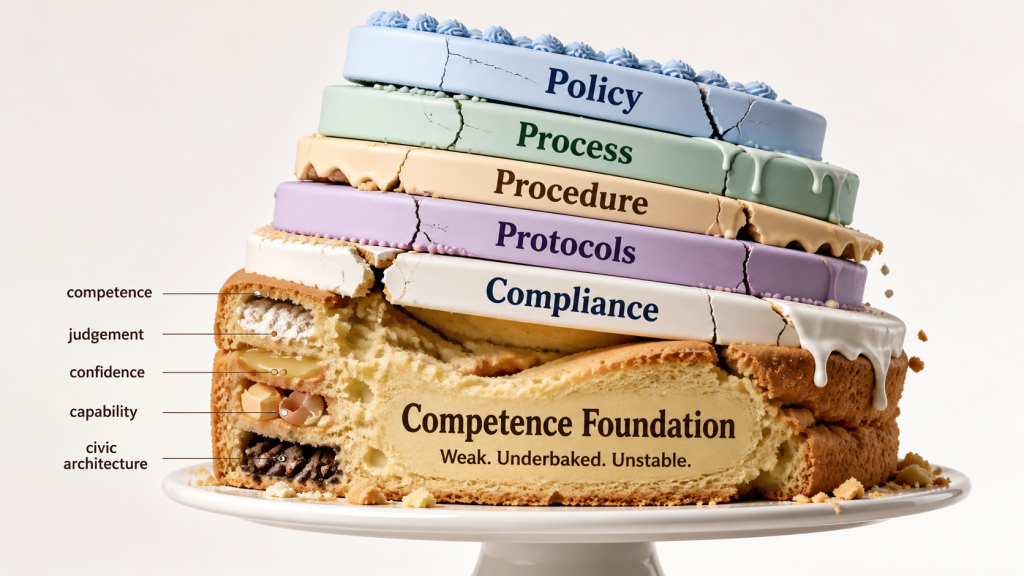
This is where the cake analogy becomes useful.
The cake is the competence foundation. Built early enough and deeply enough to carry weight.
The icing is everything that sits above it. Plans. Structures. Communications. Frameworks. Apps. Booklets. Wider institutional architecture.
The icing matters.
But if the cake is weak, it will not hold.
And if it will not hold, the icing becomes little more than decoration.
To my mind, that is why the UK keeps returning to the same resilience themes over and over again. Not because the concerns are wrong. They are not. But because we keep trying to improve the visible structure without investing enough in the base that has to support it.
Why timing matters
And here is the really important bit.
It is far cheaper and far more effective to build capacity and capability in from the beginning than to try to bolt them on at the end, when the gap has already opened up.
Build competence early and the return compounds.
Judgement improves.
Confidence improves.
Preparedness improves.
Social cohesion improves.
Over time, the wider resilience benefits begin to stack.
That is why the Nordic evidence matters. Not because they found some magic answer. They did not. The real lesson was simpler than that. They started. They kept going. They built over time.
Why we chose to begin this endeavour
Because every journey begins with a single step and this is ours.
I am genuinely grateful to the leaders and organisations that have already supported our work publicly. Their support matters because it proves something important.
The willingness to act already exists.
What it needs is encouragement, legitimacy, and a practical route through which it can grow.
That is precisely why we chose to begin with the Empty Minute awareness campaign.
Not because awareness is enough.
But because waiting is not.
The aim is to get the conversation started, bring together a coalition of the willing, and help create the civic legitimacy from which deeper, longer-term work such as PRUK can grow.
In conclusion
Yes, the inquiry matters.
Yes, the NPC has made a valuable contribution.
Yes, the establishment diagnosis is instructive.
But if all it does is reinforce what is already broadly known, without changing the narrative or building the base, then I am not sure very much will change.
That, for me, is now the question.
Not “What are the risks?”
But “What are we waiting for?”

