
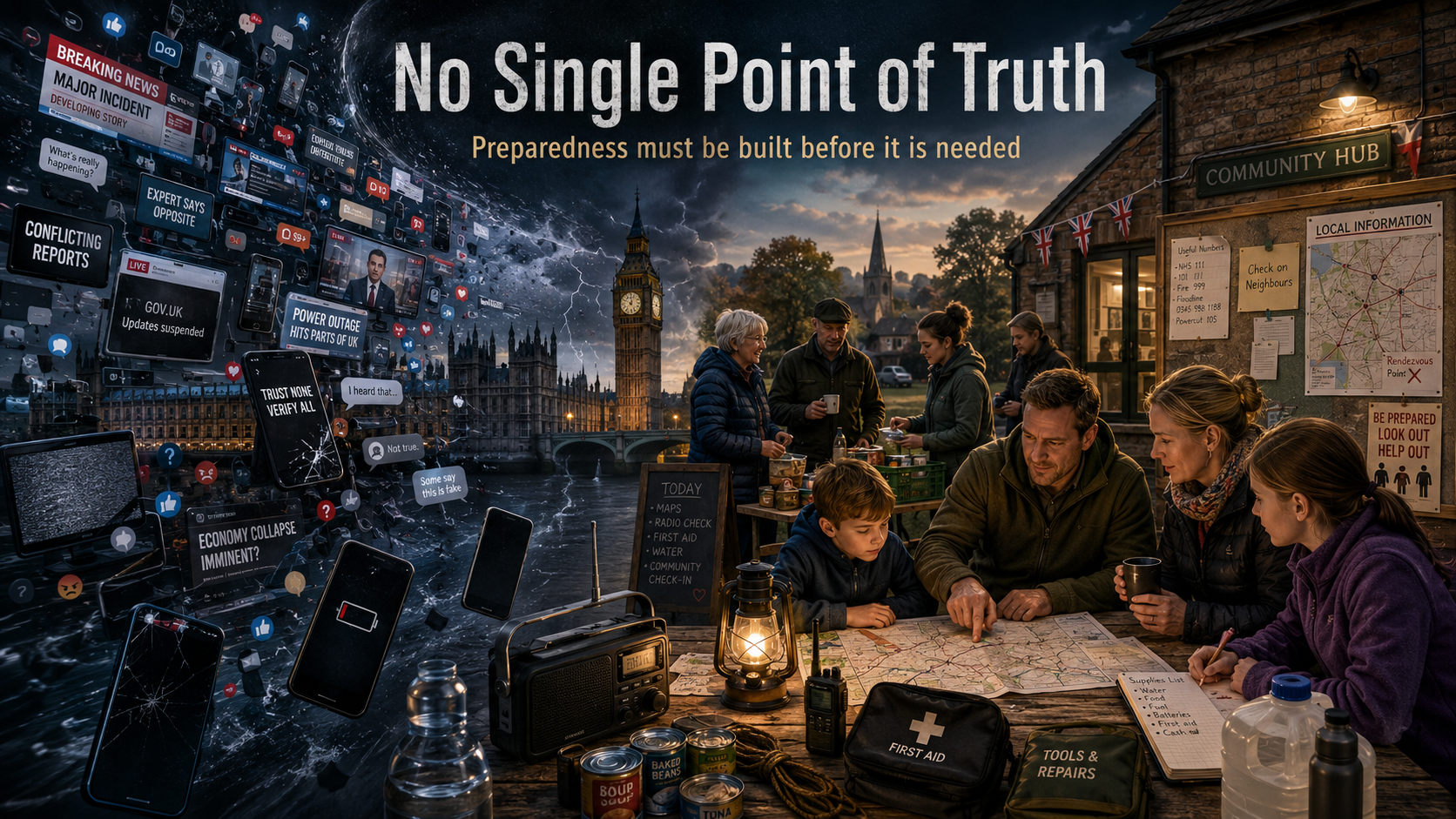
No Single Point of Truth: Why Preparedness Must Be Built Before It Is Needed
We keep talking about resilience as though the main task is getting the message right.
It is not.
The more uncomfortable truth, exposed again in the House of Lords session on communications, is that Britain no longer has a single trusted point of truth. TV news is not that point. Government is not that point. The establishment is certainly not that point. Family, friends and peers still carry the deepest weight, as they always have, but social media has changed the scale of everything. It has not replaced those human trust networks. It has sat on top of them and amplified both benign and malign actors by several orders of magnitude, so that reach can now masquerade as authority and repetition can feel like legitimacy.
That changes the whole argument.
This is not mainly a communications problem. It is a trust problem. And once you see that, a second truth follows close behind. A society that has over-invested its faith in digital normality can very quickly discover how little of that normality is resilient at all. Under real strain, all the elegant systems thinking, clever messaging, and digital planning in the world only last if the systems beneath them do. Once those systems fail, the question becomes brutally simple: what still works?
This is where the conversation gets real.
Who can still communicate when the network fails? Who knows the fallback points? Where do we get food or water when they run out? How do we cope if social unrest breaks out? And beyond all of that, how patient would the population be if modern convenience suddenly stopped?
That point about water matters more than many people realise. We can cope without a great many modern comforts for a while. We do not cope for long without water. If supply is cut for whatever reason, the damage to health begins quickly. In an analogue world, local knowledge is not some charming extra. It is part of the survivability layer.
A locality that still knows where its older water sources are, whether they are usable, and how to access them in hours is in a very different position from one that has to begin asking those questions days into the crisis. That is the difference between discomfort and the beginnings of a public health emergency.
A society that has forgotten where its water is, how to reach it without electricity, and who knows how to organise access under pressure is not resilient. It is merely comfortable.
That, to my mind, was the most revealing part of the communications session. Some practical truths surfaced, but they were not really followed through. The conversation kept drifting back towards the safer ground of messaging, trust, and explanation, when the more important point was sitting there in plain sight. Under real pressure, what matters is not simply what message is sent. It is what survives when the centre cannot communicate clearly, cannot coordinate digitally, and cannot command belief.
That is the real Westminster to Wetherspoons problem.
Not as a slogan, but in its full meaning. Can an idea travel from government, Parliament, think tanks, regulators, and expert panels into ordinary life, where the country in all its variety actually lives? Can it become something people understand, discuss, and act on without needing a policy glossary to decode it? Can it survive the jump from official language to family habit?
Britain has done this sort of thing before. In the 1980s, the “Tell Sid” campaign was used to encourage ordinary people to buy shares in the privatised British Gas. It worked because it made something that had previously felt distant, technical, and not for ordinary people suddenly intelligible, portable, and personally relevant. People who had never bought shares before understood what was being offered, why it mattered, how to take part, and how it might positively affect them and their families. The message was simple, repeated, socially transmissible, and rooted in lived life. It made participation thinkable.
We have not done anything comparable with preparedness.
And that is not because it cannot be done. It is because we are still trying to explain the wrong thing in the wrong language. “Resilience” is a policy word. It means different things to different people and very little to most of the public. It does not tell people what you want them to do, what part they play, or why it matters to their family. So, the country ends up stuck in a familiar trap: serious people discussing important problems in terms that never quite land in ordinary life.
But under real strain, life does not wait for better wording. It gets simpler, faster, and harsher.
That is why the answer does not begin with another campaign from the centre. It begins with rebuilding the practical layer underneath the system: trusted relationships, local memory, simple fallback methods, shared expectations, useful habits, and people who know what to do before they are told.
And if that is true, then the obvious place to begin is early.
Not through fear. Not through burden. Not by turning children into doomsday preppers. But through challenge, confidence, teamwork, signalling, first aid, navigation, practical responsibility, local knowledge, and the quiet understanding that you can still be useful when the world around you stops behaving normally. Cubs. Scouts. Guides. Cadet Forces. Outdoor learning. Shared effort. Practical self-sufficiency. Delivered that way, it is not only wiser. It is more enjoyable, more affordable, and far more likely to last.
Preparedness taught young is not a burden. It is a gift.

