
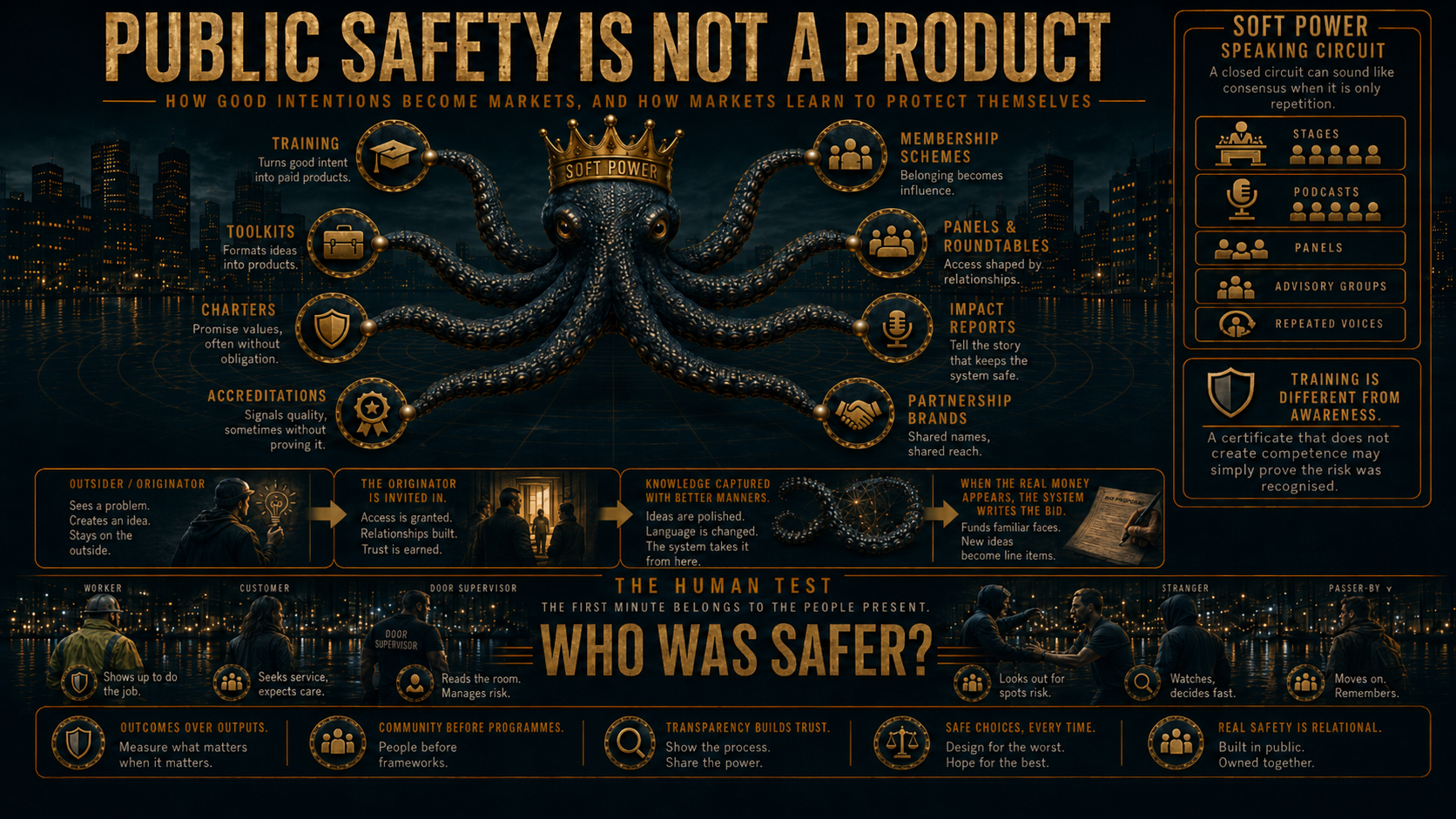
Public Safety Is Not a Product: How good intentions become markets.
Public safety is not a product.
At least, it was not supposed to be.
It was supposed to be something we built between us: people, places, businesses, services, communities and institutions all doing their part. It was supposed to mean that when someone is frightened, threatened, vulnerable or at risk, the system around them does more than point to a logo, a certificate, a charter or a poster.
It actually helps!
Yet somewhere along the way, public safety became a marketplace. Not because everyone inside it set out with bad intentions. That would be too easy. Most people in this space will tell you they care about harm, vulnerability, violence, women’s safety, business crime, staff abuse, nightlife, town centres and public confidence. However, good intentions still need feeding.
That is the part we do not like to talk about, because it feels unkind. The people may be decent. The cause may be real. The work may matter. Does matter. But the organisation still must survive. Staff need paying. Projects need renewing. Partners need keeping close. Funders need confidence. The board needs assurance. The sector needs a story it can repeat back to itself.
And slowly, almost invisibly, the thing built to solve a problem develops a second purpose.
It must keep itself alive if its goowork is to continue.
That is how a market grows. Not in one dramatic moment, but through thousands of small, reasonable steps. A useful training session becomes a product. A helpful checklist becomes a toolkit. A voluntary pledge becomes a charter. A local partnership becomes a model. A meeting becomes a roundtable. A roundtable becomes consensus. A familiar voice becomes an expert. An expert becomes the safe person to invite back next year.
That is what makes it powerful.
The market does not announce itself as a market. It calls itself collaboration, professionalisation, best practice, awareness, accreditation, partnership and progress. Much of that may be true. But once the machinery exists, it must keep moving.
And machinery that must keep moving eventually learns what to consume.
You can see the products everywhere: training, toolkits, charters, flags, accreditations, membership schemes, preferred-provider lists, pledges, webinars, awards, podcasts, roundtables, impact reports, evidence packs, signatory counts and partnership brands. Some may be useful. Some may be necessary. But none of them should be mistaken for public safety itself.
There is an irony here for businesses too. Awareness can remain vague. Training is different. Once a business pays for training to manage a recognised risk, it has moved beyond saying, “we care about this.” It has acknowledged the risk, chosen a response, created a record and implied that staff should now be better able to act.
That may protect people if the training is good, understood, practised and supported. But if the training does not become competence, it may protect nobody. Worse, it may leave the business with a certificate that proves it knew the risk existed, while doing little to show that the people on the floor were actually ready for the moment. A certificate that does not create competence may not reduce exposure or liability.
It may simply prove the risk was recognised.
That is the quiet danger of the public safety marketplace. It can sell reassurance to the organisation while shifting the real test onto the worker, the customer, the door supervisor or the frightened person asking for help.
This is where the soft power connected organisations can generate enters.
Soft power is the part we rarely name, because it does not look like power. It looks like partnership, access, recognition, invitation, endorsement, platforms, advisory groups, panels, steering groups, shared language and photographs beside familiar logos.
It is the power to decide who is credible before the public ever sees the evidence. It is the power to decide who gets invited into the room, who gets repeated, who gets funded, who gets described as an expert, and whose idea becomes serious enough to be turned into a programme.
That is why the speaking circuit matters. The same type of people appear on the same type of panels, join the same type of roundtables, endorse the same type of toolkits and use the same language about partnership, best practice, awareness, culture change, accreditation, collaboration and confidence.
All of it sounds reasonable. Much of it may be reasonable. But a closed circuit can sound like consensus when it is only repetition.
And once the circuit exists, it must keep feeding itself. It needs stories, examples, lived experience, case studies, urgency and moral weight. Very often, the most useful stories are held by people outside the market.
The person who saw the gap first. The person who lived the harm. The small organisation that built the idea before it became fundable. The frontline worker who knows what does not work. The campaigner who carried the issue long before it became safe to discuss. These people are not always pushed away.
Sometimes they are invited in.
That is what makes it so difficult to challenge. The originator is listened to. Their story is welcomed. Their language is borrowed. Their insight gives the room moral weight. They may even be thanked. It is knowledge capture with better manners.
But, when the real money appears, it’s those within the system who write the bid!
The funded version arrives later, softened into a toolkit, a training module, a pledge, a framework or a campaign that fits the machinery better. The idea survives, but the person who brought it into view does not always come with it.
That is not a conspiracy. It is what happens when public safety becomes a market and the market learns how to recognise itself. It recognises polish. It recognises partners. It recognises boards, logos, case studies, conferences and people who can sit on a panel and say the sector is moving in the right direction.
It does not always properly acknowledge or recognise the person who saw the gap first.
So, the question is not whether the marketplace can produce activity. Of course it can.
It can produce meetings, reports, toolkits, training, campaigns, charters, panels and photographs of serious people agreeing that the work matters.
The harder question is whether any of it survives contact with the moment it was meant to serve.
That moment usually arrives quietly. Before the report is written. Before the next roundtable meets. Before the certificate is found in a file. Before the official response reaches the scene. Someone is already there.
A worker. A customer. A door supervisor. A friend. A stranger. A passer-by.
That is where public safety stops being language and becomes reality. It is no longer a product, a pledge, a badge, a framework or a promise. It is a frightened person meeting the system we built around them.

