
The Chipping Norton Conundrum: From Passive Public to Active Citizen
One of the unexpected benefits of watching the House of Lords Inquiry into National Resilience has been learning how parliamentary committees actually work. As someone who had never followed one this closely before, I have found the process incredibly instructive.
Committees cannot simply declare what they suspect to be true. They have to build the evidence, question witnesses and allow the system to explain itself in its own language. Only then can they show where answers become partial, responsibilities blur and no single witness appears able to speak for the whole.
This is what makes this inquiry increasingly interesting.
The committee’s call for evidence was broad enough to go well beyond a review of plans, structures and capabilities. It asked about interconnected risks, whole-of-society resilience, public preparedness, historical lessons and the strategic weaknesses that may sit within the present system. Read in that light, the inquiry is not only testing whether the UK is prepared. It is testing whether the resilience settlement inherited from the Cold War and the decades that followed still makes sense in the world we now inhabit (House of Lords National Resilience Committee, 2026a).
I have come to think of the missing piece within that settlement as the Chipping Norton Conundrum. I will come back to what I mean by that, but first it is worth understanding how we arrived here.
Phillip Wood’s written evidence is important because it reminds us that earlier civil defence thinking rested on practical functions such as shelter, recovery and rescue. Civil protection was not simply a matter of plans held in Whitehall. It involved places, people, local capability and the practical business of saving life after attack (Wood, 2026).
The Cold War altered the balance because the scale of the anticipated destruction changed the meaning of both rescue and survival. Under the logic of Mutually Assured Destruction, surviving a full strategic nuclear exchange was already doubtful. The prospect of meaningful organised rescue was more doubtful still. If the whole country had been subjected to overwhelming attack, there might have been too little functioning state, infrastructure or population left to rescue anyone in any recognisable sense.
That had its own brutal logic. Survival became the language available to ordinary people because rescue could no longer be treated as the organising assumption.
The end of the Cold War produced a different settlement. The peace dividend reduced urgency. The island dividend encouraged the belief that geography continued to protect us. The distance dividend allowed serious conflict to feel physically and psychologically remote. NATO provided strategic shelter, civil defence was reduced or absorbed, and preparedness became something increasingly done by specialists on behalf of the public rather than understood and shared by the public.
For a time, those assumptions appeared to hold. The problem, as this inquiry recognises, is that they no longer describe the world facing us now.
The United Kingdom is not at war in the formal or declared sense, yet many of the effects once associated with conflict can now be imposed below the threshold at which war is named. Sabotage, cyberattack, hostile-state interference and attacks on critical infrastructure can disrupt power, communications, fuel, transport, water, food distribution and public confidence without the destruction once associated with open warfare (HM Government, 2025).
The Government’s Resilience Action Plan also recognises that the most serious risks cross institutional, geographical and sectoral boundaries, requiring capabilities and organisations from across society to work together (Cabinet Office, 2025).
A modern adversary does not necessarily need to flatten a city. It may be enough to disable part of it. It does not have to defeat the country if it can create sufficient confusion, delay and mistrust for the system to hesitate while an affected population is left exposed.
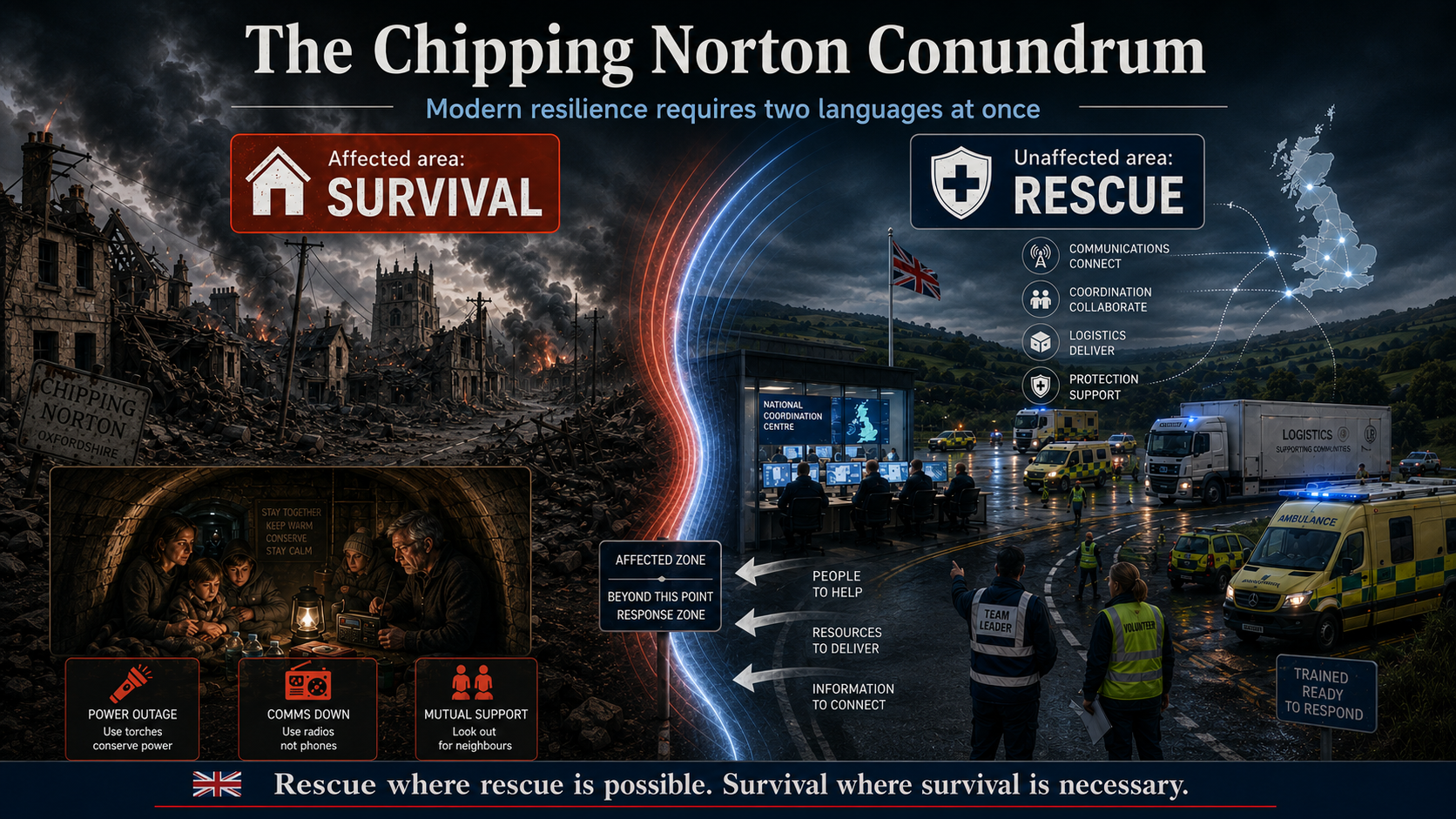
What has changed is that many modern attacks may now be survivable, even when they are devastating. A town, district, infrastructure network or local population may be badly affected while the rest of the country remains intact. Survival inside the affected area and rescue from outside it are therefore both possible.
This is the uncomfortable space between peace language and war reality.
It’s also where Chipping Norton entered my thinking.
I did not choose Chipping Norton because it is especially vulnerable or strategically important. Quite the opposite. It works because it feels ordinary, comfortable and unlikely. It is not the sort of place most people imagine becoming the centre of a catastrophic event.
Nobody knows where the next event will happen. Nobody knows whether they will find themselves inside it or beyond its immediate reach.
A serious event does not simply test the resilience of institutions. It reallocates responsibility.
Inside Chipping Norton, the immediate reality would be survival under uncertainty. People may not know what has happened, how far it extends or whether help is coming. Communications may have failed. Authority may be absent. There may be nobody able to enforce the ordinary rules or offer any certainty about when normality will return.
Necessity would take over. People would protect themselves, their families and those around them because waiting might no longer be a safe or even possible choice.
Outside Chipping Norton, the reality would be different. Government, responders and institutions would be trying to understand the event, prevent wider harm and organise the rescue. They would still be bound by law, authority, responsibility and accountability. They could not simply cast the rules aside because the circumstances were difficult. The country would therefore be living in two realities at once.
Inside, survival can’t wait. Outside, rescue can’t abandon accountability. That’s the conundrum.
It also reveals a deeper challenge for the inquiry: how citizens might be helped to understand the new role this changed environment may require them to play.
For decades, preparedness has largely been something done by specialists on the public’s behalf. Citizens have been expected to follow instructions, remain calm and wait for help. Whole-of-society resilience asks something different. Depending upon where the event happens, the same citizen may find themselves trying to survive, helping with the rescue or doing both.
Lord Farmer’s point about civic identity may offer one of resilience’s least visible but emotionally powerful tools. People are more likely to act for one another when they understand themselves not simply as individuals waiting for help, but as citizens who belong to something shared and have a part to play.
The oral evidence on public preparedness supports the importance of that distinction. The committee heard that the United Kingdom retains comparatively strong levels of community connection, but lacks the individual knowledge and ‘muscle memory’ that would help people respond effectively when familiar systems and instructions fail (House of Lords National Resilience Committee, 2026b).
Whole-of-society resilience begins when citizenship stops being passive.
In the end, a citizen’s role will not be assigned by policy, status or intention. It will be assigned by circumstance. Therefore, the task is not to tell people in advance which role they will occupy. Nobody can know that. The key is to make sure they understand the duality before the event decides for them. Because no one should be discovering their new role for the first time after the emergency has already begun.
The hard truth is, no one knows which role they might end up playing, in their own version of Chipping Norton.
References
Cabinet Office (2025) UK Government Resilience Action Plan. London: Cabinet Office. Available at: GOV.UK (Accessed: 13 July 2026).
HM Government (2025) National Security Strategy 2025: Security for the British People in a Dangerous World. London: HM Government. Available at: GOV.UK (Accessed: 13 July 2026).
House of Lords National Resilience Committee (2026a) ‘Call for evidence launched into national preparedness and resilience’, 9 March. London: UK Parliament. Available at: UK Parliament Committees (Accessed: 13 July 2026).
House of Lords National Resilience Committee (2026b) Corrected oral evidence: National Resilience, 11 June 2026, Evidence Session No. 10, Questions 92–103. London: UK Parliament. Available at: UK Parliament Committees (Accessed: 13 July 2026).
Wood, P. (2026) Written evidence submitted to the House of Lords National Resilience Committee: NLR0065. London: UK Parliament. Published 28 May 2026. Available at: UK Parliament Committees (Accessed: 13 July 2026).

