
Resilience Is a Policy Word
The person the system did not reach
I live in Leicester. I have lived in several parts of the United Kingdom and spent much of my working life close to public safety, security, standards, assessment and emergency-related practice. Yet I only recently discovered that Local Resilience Forums existed. I also only recently encountered the National Preparedness Commission. This was despite the existence of national resilience campaigns and repeated claims that resilience is a whole-of-society endeavour.
My experience cannot tell us how many other people know about these arrangements. It can, however, tell us that the question is worth asking. If someone unusually interested in public safety can pass through decades of adult life without encountering the bodies and structures intended to support national and local preparedness, what evidence is there that the ordinary person sitting in Wetherspoons, the family on an estate, the resident of a tower block or the older person living alone knows that any of it exists?
The usual answer is to point towards websites, campaigns, consultations, voluntary organisations and published guidance. But publication is not communication. Organisational engagement is not population reach. Nominal availability is not usable capability. A message has not succeeded because it was issued. It has succeeded only when somebody has received it, understood it, retained it and can act upon it in the circumstances for which it was intended.
That is the central problem examined here. Britain does not lack resilience activity. It lacks a reliable way of showing that all that activity has reached the citizen and made them more capable of surviving the period before professional help arrives.
Resilience is a policy word
The problem is not that resilience is inherently meaningless. The problem is that we use it without saying what is expected to remain functional, against which disruption, at what minimum level, for how long and to protect which outcome.
The UK Government Resilience Framework describes resilience as a whole-of-society endeavour and calls for greater transparency and the empowerment of everyone to contribute (Cabinet Office, 2022). The UK Government Resilience Action Plan defines it as the ability to anticipate, assess, prevent, mitigate, respond to and recover from disruptive events (Cabinet Office, 2025a). These are respectable definitions. Yet once the word leaves the page, almost any approved activity can be placed beneath it: a forum, strategy, risk register, campaign, hub, exercise, training event, research programme, toolkit or funding stream.
The word then confers moral seriousness without necessarily creating an operational obligation. Engagement stands in for reach. Awareness activity stands in for public awareness. Representation stands in for participation. Planning stands in for capability. A building stands in for a functioning hub. A toolkit stands in for competence. Intended benefit stands in for demonstrated human outcome.
That is why resilience has to be defined in context. A resilient electricity network is not the same thing as a resilient council. A functioning Local Resilience Forum is not the same thing as a prepared neighbourhood. A household that has received advice is not necessarily a household that can cope when the power, water and communications fail together.
Resilience is a policy word. Survivability is a human outcome.
Another head of the octopus
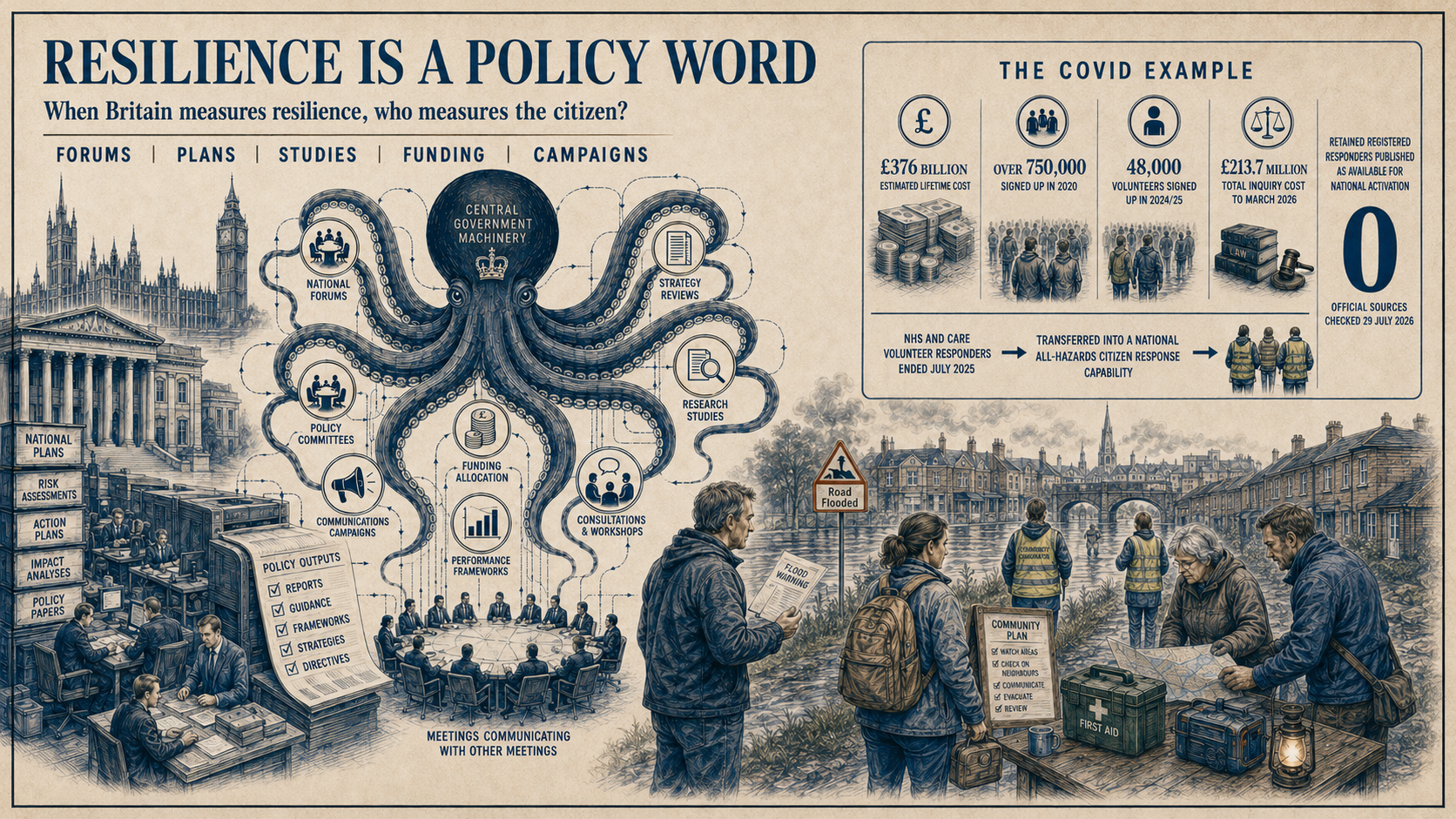
This is another head of a recurring institutional problem. I have come to think of it as the octopus problem. The octopus has no headquarters and requires no conspiracy. It appears when responsibility is spread across several legitimate organisations, each measured by its own activity, while nobody owns the final human outcome.
A genuine risk creates an emotionally powerful policy case. Organisations and professional networks gather around it. Funding supports studies, engagement, models, pilots, toolkits, reports, exercises and conferences. Each arm can show that it moved. Each organisation can account for what it delivered. Yet the person at the end of the system may remain no better able to recognise danger, make a safe decision or act before help reaches them.
Many of the professionals and volunteers involved plainly care and work conscientiously. This is not an accusation of indifference or bad faith. It is an accountability problem. Funding and assurance attach more easily to things an organisation can count: meetings held, people consulted, guidance produced, courses delivered, plans completed and partners convened. Dispersed human competence is harder to build and harder to measure, so it is too easily assumed.
The citizen remains present throughout the language. They appear as a vulnerable population, demographic category, beneficiary, communications audience, volunteer or projected casualty. They appear less often as the person who must recognise, decide and act while the organised response is still on its way.
The effect is uncomfortable. The vulnerability of ordinary people helps create the moral and financial case for resilience activity. If the emergency occurs, their deaths and injuries become part of the final accounting. Between those two points, nobody may be able to show whether those same people were ever given the understanding, competence and permission to improve their own chances.
Covid: the perfect head of the octopus
Covid-19 turned that description into something we could see. The Government mounted a response of unprecedented scale and cost. The public response was equally extraordinary: registrations to join NHS Volunteer Responders overwhelmed the original target within days, while more than 4,300 mutual-aid groups emerged, involving an estimated three million people in shopping, collecting prescriptions, sharing information and supporting people who were isolated (National Audit Office, 2021; Department for Culture, Media and Sport, 2026; Cocking et al., 2023).
Those facts matter together. Faced with what was understood to be a potentially fatal and system-overwhelming pandemic, the public did not wait to be persuaded that helping was a good idea. People stepped forward in numbers so great that the original recruitment target was overtaken almost immediately. Whatever else may be said about the British public, unwillingness was not the problem.
It also exposed an absorption problem. An early government evidence review reported that fewer than 20,000 tasks had initially been allocated through the national scheme and warned that delays allowed enthusiasm to dissipate (SPI-B, 2020). The programme later completed more than 1.6 million tasks, so it should not be described as a simple rejection of public help. Yet the sequence matters. Willingness arrived faster than the formal system could initially turn it into useful roles.
Outside the national scheme, mutual-aid groups often acted quickly because they were local and relational. They knew the streets, the people and the immediate needs. Many then struggled to continue once the emergency phase passed. Research found that infrastructure, communication, relationships and coordination were critical to effective volunteering, and that barriers to sustaining mutual aid were structural rather than simply failures of individual motivation (The Young Foundation, 2021; Cocking et al., 2023).
Then came the deeper failure. In 2022, the Government accepted a parliamentary recommendation to establish a volunteer reserve database. It said that the NHS Volunteer Responders programme already held more than 400,000 active volunteers and that the intended operating model would retain a list of people prepared to step forward during emergencies. In 2024/25, the successor NHS and Care Volunteer Responders programme still had 48,000 volunteers signed up and was being used across all 42 Integrated Care System areas in England (HM Government, 2022; Royal Voluntary Service, 2025). This was not an imaginary capability. A large, nationally connected and measurable cohort existed.
Then the national programme ended. Tasks ceased after 31 May 2025 and Royal Voluntary Service records that the programme ended in July. Existing responders were invited to register their interest through a new NHS recruitment portal, but no figure was published showing how many transferred, remained available or could still be activated. The Government said that it was not losing the volunteers. That may be true of the people, some of whom will still be helping through charities, NHS trusts and local groups. But I could identify no published UK-wide register, or national all-hazards register, showing how many were retained and are available for activation. A recruitment portal listing local opportunities is not the same thing as a national reserve that can be counted, called and deployed (Hansard, 2025; Royal Voluntary Service, 2025).
Meanwhile, the estimated lifetime cost of the Government’s Covid-19 measures was £376 billion. By 31 March 2026, the UK Covid-19 Inquiry itself had cost £213.7 million, excluding the separate costs incurred by government departments in responding to it (National Audit Office, 2024; UK Covid-19 Inquiry, 2026). The Inquiry may be necessary. Learning and accountability matter. But set those sums beside the public mobilisation already described. After all that effort, finance and goodwill, the Government cannot provide the public with a current national number of retained responders available for activation.
This does not prove that no volunteers remain willing. It proves something more specific: no nationally retained cohort available for activation can now be publicly counted.
The public did not fail the resilience system. The resilience system failed to retain the public.
What Local Resilience Forums were created to do
That national failure helps explain why Local Resilience Forums matter to this argument, but fairness still matters. LRFs were not created as public membership organisations, separate emergency services or bodies with a general duty to train every citizen. Their foundation lies in the Civil Contingencies Act 2004 and the Contingency Planning Regulations 2005. The legislation requires relevant Category 1 responders to cooperate through a forum covering each local resilience area.
Their essential original outcome is the effective, coordinated discharge of the responders’ civil-protection duties. Risk assessment, emergency planning, business continuity and arrangements for warning and informing the public remain duties of the relevant organisations. The forum enables those organisations to cooperate.
An LRF may therefore perform its original coordination purpose even though most local residents do not recognise its name. Public unfamiliarity alone does not prove institutional failure. But the citizen is not irrelevant: Category 1 responders must make civil-protection information available and maintain arrangements to warn, inform and advise the public. Government guidance says this should help communities understand the risks they face and the actions they need to take. The ordinary citizen has no equivalent general legal duty to keep supplies, attend training or possess an emergency plan; responsibility for maintaining effective arrangements belongs to the responders (Cabinet Office, 2012; 2013).
The distinction is crucial. A functioning forum is evidence of institutional coordination. It is not evidence that the citizen knows what to do, where to go or how to remain functional until that coordinated response reaches them.
The LRF is not the villain of this paper. It is where the national promise meets the local citizen, and where the category error becomes easiest to see.
The Resilience Action Plan brings us back to the same question
The UK Government Resilience Action Plan, published in July 2025, places the whole-of-society claim beyond doubt. Its second objective is to enable the whole of society to take action to increase its resilience. It says a fundamental cultural shift is required and recognises that, during widespread power or water failure, the authorities may be unable to reach everyone who needs support in the first hours or days (Cabinet Office, 2025a).
The 2026 Implementation Report repeats that a profound cultural and behavioural change is required. General advice already exists through GOV.UK/Prepare, but the new household advice and multi-year public engagement campaign described in the report are future commitments, promised for later in 2026 and not yet available when this article was completed (Cabinet Office, 2026a).
These are material commitments. The RAP has not ignored the public. In fact, it recognises the central truth on which citizen survivability rests: there will be circumstances in which the emergency services and public authorities cannot reach everybody quickly enough. During that period, the first minute, and sometimes the first hours or days, belongs to the people who are already there.
The implementation report can count 4,500 civil servants trained through the Crisis Management Excellence Programme. It does not publish an equivalent measure of demonstrated citizen competence. The RAP recognises the citizen as necessary. It does not yet measure the citizen as capable.
Leicester is not an abstract example
This brings me back to Leicester and to Thurncourt, the ward in which I live. The Leicester, Leicestershire and Rutland Local Resilience Forum provide a Community Risk Register, emergency information, a Community Response Plan toolkit and webinars. The Risk Ready Communities programme encourages residents to prepare household plans and supplies, understand local risks, volunteer and develop Community Response Plans (LLR Resilience Forum, 2026a; Leicestershire County Council, 2026).
These are legitimate and potentially valuable activities. They make the citizen an expected actor. People are expected to understand the risk, prepare themselves, follow advice and support others where they can.
The simplest citizen test is the one I can apply from my own front door. I live here. What has changed? Who has been reached? What do we now know? What can we now do? Where do we go when normal systems fail? Who will know whether we have left, need help or remain trapped?
In the publicly accessible LLRF and Leicester City Council material I examined up to 29 July 2026, I could not locate a completed, citizen-facing Community Response Plan for an urban Leicester neighbourhood, or a public inventory showing which city neighbourhoods possess one. That does not prove no plans exist. They may be held under different titles, retained by community organisations, intended mainly for responders or contain information that should not be published.
But an arrangement that residents cannot find, recognise or understand cannot instruct them during the first minutes and hours of an emergency. The test is who received it, understood it, remembers it and can use it.
A place people might go to
The same question arose in London’s Community Resilient Hubs Pilot. It helped community venues map staff, volunteers, languages, supplies, relationships and safeguarding responsibilities. It connected venue leads with borough emergency planners and produced bespoke action plans. This was useful preparation for the organisers (British Red Cross, Groundwork London and Communities Prepared, 2025).
For the surrounding citizen, however, the published value remained prospective. The pilot did not establish how many residents knew the hubs existed, understood when to use them or could reach them. A place had been prepared that people might go to. The evidence did not show that the people knew to go there. That does not make the project worthless; it defines what the project had and had not yet achieved.
Hebden Bridge in the UK and Wellington in New Zealand move closer to an operational proposition because the citizen can see the connection. Hebden Bridge already possessed a community-controlled building, governance and trusted relationships when its Town Hall became an emergency hub during the 2015 floods (Historic England, n.d.; Bauman Lyons, n.d.). Wellington publishes local plans explaining what people can do when they arrive at a Community Emergency Hub and how needs beyond local capacity connect to the official response (WREMO, 2025a; 2025b). Neither model proves universal competence, but each makes the citizen’s role visible.
What should be measured
If resilience is to mean anything in the citizen context, it must be attached to a human function. The question is not whether people can repeat the language of preparedness. It is whether they can recognise danger and perform the action that improves survivability.
That means measuring whether people can:
- recognise the warning signs and make a safe first decision without waiting for an instruction that may never arrive;
- perform the protective action, retain it and transfer it when the real event differs from the training example;
- identify and reach a functioning local point of connection;
- signal whether a household has left, needs help or remains trapped; and
- continue to function when power, telecommunications or expected personnel are unavailable.
This is not an argument for turning citizens into substitute emergency services. It is the opposite. It defines the boundary more honestly. People should know what they can do safely, what they should not attempt and how to survive and support one another until professional capability reaches them.
From resilience activity to a survivability culture
If the problem is the substitution of information for capability, the alternative is not theoretical.
The children who evacuated in Kamaishi during the 2011 Japanese tsunami had been taught to recognise the signs and repeatedly prepared to act. They were not given permission to ignore adults. They were given the understanding, competence and permission to make the first safe move when the circumstances they had been taught to recognise appeared. Their movement then gave others permission to follow.
That is what a survivability culture looks like in practice. It is not created by telling people that resilience matters. It is created when people can recognise what is happening and know what to do next.
A resilience programme can be delivered to a population. A survivability culture has to be built with it.
Until somebody owns that outcome, resilience will remain a policy word.
The public’s willingness was not zero. But the number of retained registered responders published as available for national activation is. A big fat zero.
References
Bauman Lyons (n.d.) Hebden Bridge Town Hall’s role in the recent floods. Available at: https://baumanlyons.co.uk/news/hebden-bridge-town-halls-role-in-the-recent-floods
British Red Cross, Groundwork London and Communities Prepared (2025) Community Resilient Hubs Pilot Project. London: London Resilience. Available at: https://www.groundwork.org.uk/wp-content/uploads/2025/10/Community-Resilience-Hubs-Pilot_Final_Oct25.pdf
Cabinet Office (2012) Emergency Preparedness: Chapter 7, Communicating with the Public, Annex 7D. Available at: https://assets.publishing.service.gov.uk/media/5a74cac3ed915d3c7d527fdc/Chapter-7-Annex-7D-amends_18042012_0.pdf
Cabinet Office (2013) The role of Local Resilience Forums: A reference document. Available at: https://assets.publishing.service.gov.uk/media/5a79ce28ed915d6b1deb379d/The_role_of_Local_Resilience_Forums-_A_reference_document_v2_July_2013.pdf
Cabinet Office (2022) The UK Government Resilience Framework. Available at: https://www.gov.uk/government/publications/the-uk-government-resilience-framework
Cabinet Office (2025a) UK Government Resilience Action Plan. Available at: https://www.gov.uk/government/publications/uk-government-resilience-action-plan
Cabinet Office (2026a) The UK Government Resilience Action Plan: 2026 Implementation Report. Available at: https://www.gov.uk/government/publications/the-uk-government-resilience-action-plan-2026-implementation-report
Civil Contingencies Act 2004, c.36. Available at: https://www.legislation.gov.uk/ukpga/2004/36/contents
Civil Contingencies Act 2004 (Contingency Planning) Regulations 2005, SI 2005/2042. Available at: https://www.legislation.gov.uk/uksi/2005/2042/body
Cocking, C., Vestergren, S., Ntontis, E. and Luzynska, K. (2023) ‘All together now: Facilitators and barriers to engagement in mutual aid during the first UK COVID-19 lockdown’, PLOS ONE, 18(4), e0283080.
Department for Culture, Media and Sport (2026) Impacts of public services being delivered by civil society organisations. Available at: https://www.gov.uk/government/publications/impacts-of-public-services-being-delivered-by-civil-society-organisations
Government of Japan (2013) Lessons from Disasters: Disaster Management Education in Kamaishi. Available at: https://www.gov-online.go.jp/eng/publicity/book/hlj/html/201303/201303_02.html
HM Government (2022) The government’s response to the Health and Social Care Committee and Science and Technology Committee joint report: Coronavirus: lessons learned to date. Available at: https://assets.publishing.service.gov.uk/media/62ab0d2ad3bf7f04a1c4685e/government-response-to-the-hscc-and-science-and-technology-committee-joint-report-coronavirus-lessons-learned-to-date-print-ready.pdf
Historic England (n.d.) Hebden Bridge Town Hall. Available at: https://historicengland.org.uk/advice/caring-for-heritage/take-ownership/hebden-bridge-town-hall/
Leicestershire County Council (2026) Risk Ready Communities. Available at: https://www.leicestershire.gov.uk/news/risk-ready-communities
LLR Resilience Forum (2026a) Prepare yourself and your community. Available at: https://www.llrresilienceforum.org.uk/prepare-yourself
National Audit Office (2021) The government’s preparedness for the COVID-19 pandemic. Available at: https://www.nao.org.uk/reports/the-governments-preparedness-for-the-covid-19-pandemic/
National Audit Office (2024) Investigation into the UK Health Security Agency’s health security campus programme. Available at: https://www.nao.org.uk/wp-content/uploads/2024/02/investigation-into-the-uk-health-security-agencys-health-security-campus-programme-report.pdf
Royal Voluntary Service (2025) Trustees’ Annual Report and Financial Statements 2024-25. Available at: https://www.royalvoluntaryservice.org.uk/media/jelke3yw/annual_report_and_accounts_2024-25.pdf. See also: https://www.royalvoluntaryservice.org.uk/our-services/advice-support/stay-safe-warm-and-well/
UK Parliament (2025) NHS and Care Volunteer Responders Service, House of Commons Hansard, 19 May. Available at: https://hansard.parliament.uk/commons/2025-05-19/debates/3C9707A8-7619-43FC-98D5-78B53DF1DA37/NHSAndCareVolunteerRespondersService
SPI-B (2020) The impact of financial and other targeted support on rates of self-isolation or quarantine. Available at: https://www.gov.uk/government/publications/spi-b-the-impact-of-financial-and-other-targeted-support-on-rates-of-self-isolation-or-quarantine-16-september-2020
The Young Foundation (2021) Understanding local patterns of volunteer activity during COVID-19. Available at: https://assets.publishing.service.gov.uk/media/621505838fa8f5490cf51252/Understanding_local_patterns_of_volunteer_activity_during_COVID-19.pdf
UK Covid-19 Inquiry (2026) Financial Report for Quarter 4 2025-26, to 31 March 2026. Available at: https://covid19.public-inquiry.uk/documents/uk-covid-19-inquiry-financial-report-for-quarter-4-2025-26/
Wellington Region Emergency Management Office (WREMO) (2025a) Community Emergency Hubs. Available at: https://www.wremo.nz/get-ready/community-ready/community-emergency-hubs
Wellington Region Emergency Management Office (WREMO) (2025b) Wellington Region Community Emergency Hub Guide. Available at: https://www.wremo.nz/assets/Hub-Guides/Regional-Hub-Guide-2025/Wellington-Region-Hub-Guide-July-2025.pdf
Wellington Region Emergency Management Office (WREMO) (2025a) Community Emergency Hubs. Available at: https://www.wremo.nz/get-ready/community-ready/community-emergency-hubs
Wellington Region Emergency Management Office (WREMO) (2025b) Wellington Region Community Emergency Hub Guide. Available at: https://www.wremo.nz/assets/Hub-Guides/Regional-Hub-Guide-2025/Wellington-Region-Hub-Guide-July-2025.pdf

