
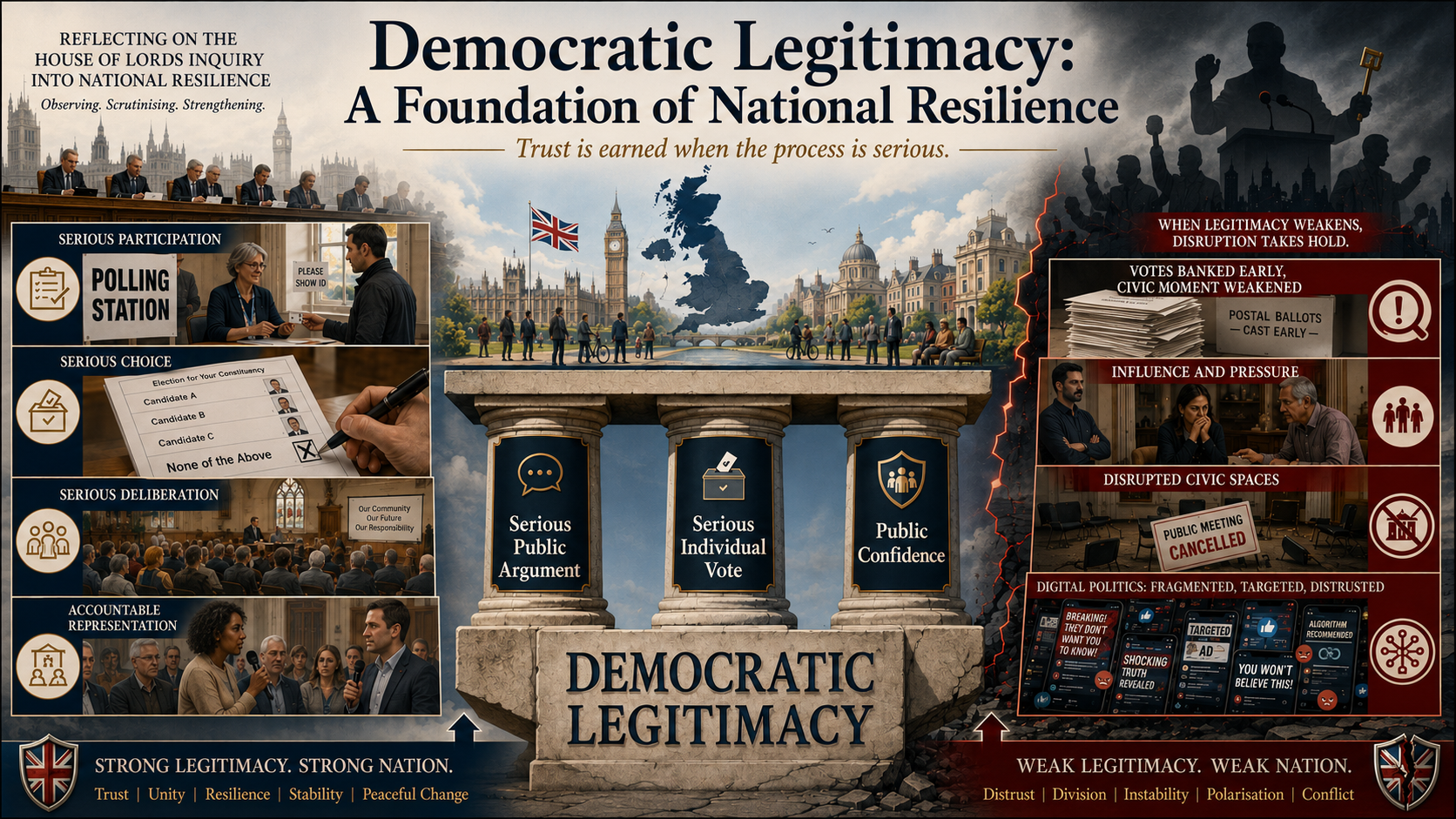
Democratic Legitimacy the Foundation of National Resilience
One of the encouraging things about the House of Lords Inquiry into National Resilience is that it keeps returning to the question of democratic legitimacy.
That matters.
It shows an understanding that resilience is not only built in power stations, supply chains, emergency plans, cyber systems, water networks, food distribution and risk registers. Those things are vital, of course they are. But the deeper strength of a country also rests on whether people still believe they are part of it.
That is the opportunity in front of us.
If we are serious about resilience, we have a chance to make democratic participation feel meaningful again. To remind people that citizenship is not passive. To rebuild the connection between voice, responsibility, representation and trust. To show that the public are not just people to be managed in a crisis, but people whose confidence must be earned long before the crisis arrives.
This is why democratic legitimacy matters.
In a crisis, government may need people to be patient, to co-operate, to accept disruption, to follow advice and to make sacrifices. But that trust cannot simply be summoned when the lights go out, the water fails, the roads close or the supply chain breaks. It must be built in ordinary times, through ordinary acts that still feel serious enough to command respect.
And few acts are more serious than the vote.
Not the count. Not the swingometer. Not the election night map. The vote itself. One person. One pencil. One mark. One quiet moment where power returns to the people and asks for permission again. That is what I think we have become far too casual about.
The vote is not just how we choose a government. It is how a free people remind themselves that the country still belongs to them.
That is why the shared civic moment matters. An election should feel like the country pausing together. Not agreeing together, because we never will and nor should we, but recognising that this is the moment when authority comes back to us. It is the moment when the citizen is not a target, a demographic, a postal return, a party habit or a tactical calculation, but a voice. It is a moment worthy of national celebration.
That may sound romantic, but I do not think it is.
One vote may feel small, like one wave hitting a cliff, but cliffs fall because waves keep coming. Sometimes the wave that looks no different from all the others is the one that finally helps bring the cliff down. That is how people should be made to feel about voting. Not that they are being managed or harvested, but that they are part of the force that shapes the country.
The challenge is that we have allowed that moment to thin out.
Before the vote, too much of the argument has become controlled, fragmented and remote. Candidates appear through clips, slogans, social media fragments, party lines and managed visits. The older discipline of standing in front of real people, in real rooms, taking awkward questions and proving that you are up to the task has been weakened.
That matters because democracy is not just a counting machine. It is supposed to be a public contest of ideas. A candidate who cannot win may still say something that matters. A voter who is angry may still be asking the right question. Consequently, a room that begins divided may at least allow people to leave with a better understanding of each other than when they arrived.
It’s not nostalgia. It’s democratic seriousness.
It also matters because we are not electing a president. Our parliamentary system is supposed to be based on electing an individual to represent our constituencies. A person to carry a constituency voice into Parliament. Yet too often the name on the ballot paper has disappeared behind a colour. This does not mean pretending parties do not exist. It means refusing to let the party label do the work that the candidate should be doing.
Safe seats can become party assets. Party machinery can carry favoured insiders, advisers, family connections and people with the right networks into Parliament without them ever being properly tested by the public they seek to represent. They may be clever. They may be ambitious. They may even become good MPs. But that is not the point. The point is that the public should not be treated as the final administrative hurdle in a career path designed somewhere else.
If citizens are expected to show up, candidates should be expected to stand up.
That brings us to postal voting, and I think we need to be honest about this. I do not see postal voting mainly as an access issue. Necessary access should remain. There will always be people serving away, people in hospital, people in care settings, some disabled voters, some carers and others with serious barriers who need proper provision.
The line is not between people who vote in person and people who cannot.
The line is between necessity and convenience.
Convenience-based postal voting is different because it has helped turn a shared civic moment of democratic renewal into a scattered administrative process. Once votes can be banked early, before the argument has fully matured, politics adapts around that. Parties do not have to keep persuading right up to the end. They can harvest habit, inherited loyalty, household influence, fear, tactical calculation and community pressure at scale.
This weakens the meaning of the vote, even if every vote is counted accurately.
The point is not that every postal vote is suspect. The point is that a system can be lawful and still weaken the perception of legitimacy. That matters because perception is not a side issue in democracy. If enough people can be persuaded that the vote was harvested, pressured, banked or corrupted, then trust has already been damaged. And once that door is open, bad actors will walk through it.
This is why the polling station should be revered. It creates a pause. It gives the voter one final moment as an individual citizen, away from the campaigner, the household, family expectation, community pressure and the noise. They may choose the party they always intended to choose. They may change their mind. They may decide none of the candidates has earned their support. But they choose in the moment, at the end of the argument, not before the argument has properly finished.
The distinction matters.
Because what we are seeing now is a politics that asks too many people what they fear, rather than what they believe in. At the 2024 general election, almost one in three voters said they voted tactically. That is not just an interesting election statistic. It is an emotional clue to what has happened to our politics.
Those voters still made a choice. We should not pretend otherwise. But millions of people were not simply voting for the future they wanted. They were voting to stop the future they feared. They were voting defensively. They were voting against. They were accepting damage limitation because aspiration no longer felt like the practical option in front of them.
That is not healthy democratic consent. It is democratic sadness.
That is why mandatory participation must be part of the conversation going forward. We must never forget the vote was not gifted to ordinary people as an administrative convenience. It was fought for, suffered for, organised for and defended at terrible cost. That places a responsibility on us: not to support any party, candidate or programme we do not believe in, but to take part in the democratic moment itself.
This is not some strange idea from the edge of democratic thought; a number of democracies already treat voting as a civic duty in one form or another. It’s also why we need to put “none of the above” on the ballot paper. It protects the citizen from forced consent. It allows people to turn up and say, formally and honestly, that none of the candidates has earned their vote.
Crucially, this is not apathy. It is democratic refusal.
And it turns the accusation back where it belongs. The divisive position is not asking citizens to take part in a shared democratic moment. The divisive position is allowing millions to disappear into silence and then pretending that silence is consent. Giving people “none of the above” is not weakening democracy; it is giving democratic refusal an honest place to stand.
A citizen who turns up and says “none of the above” is strengthening democracy by telling the truth.
That would change the emotional contract between politics and the public. Citizens would be expected to take part because rights and responsibilities belong together. Politicians, in return, would have to offer something worthy of that participation. They would have to inspire, persuade and make aspiration feel serious again.
Then in a crisis, the state will have earned the right to ask people to trust it, wait, listen, co-operate, accept hardship and put the needs of others before themselves. That trust is earned in ordinary times, through institutions that treat people as citizens and human beings rather than votes to be harvested. A trust earned by building democratic resilience into the system, one person, one pencil one mark, one vote at a time.
Without that, democratic legitimacy is little more than a house of cards in a hurricane.

