
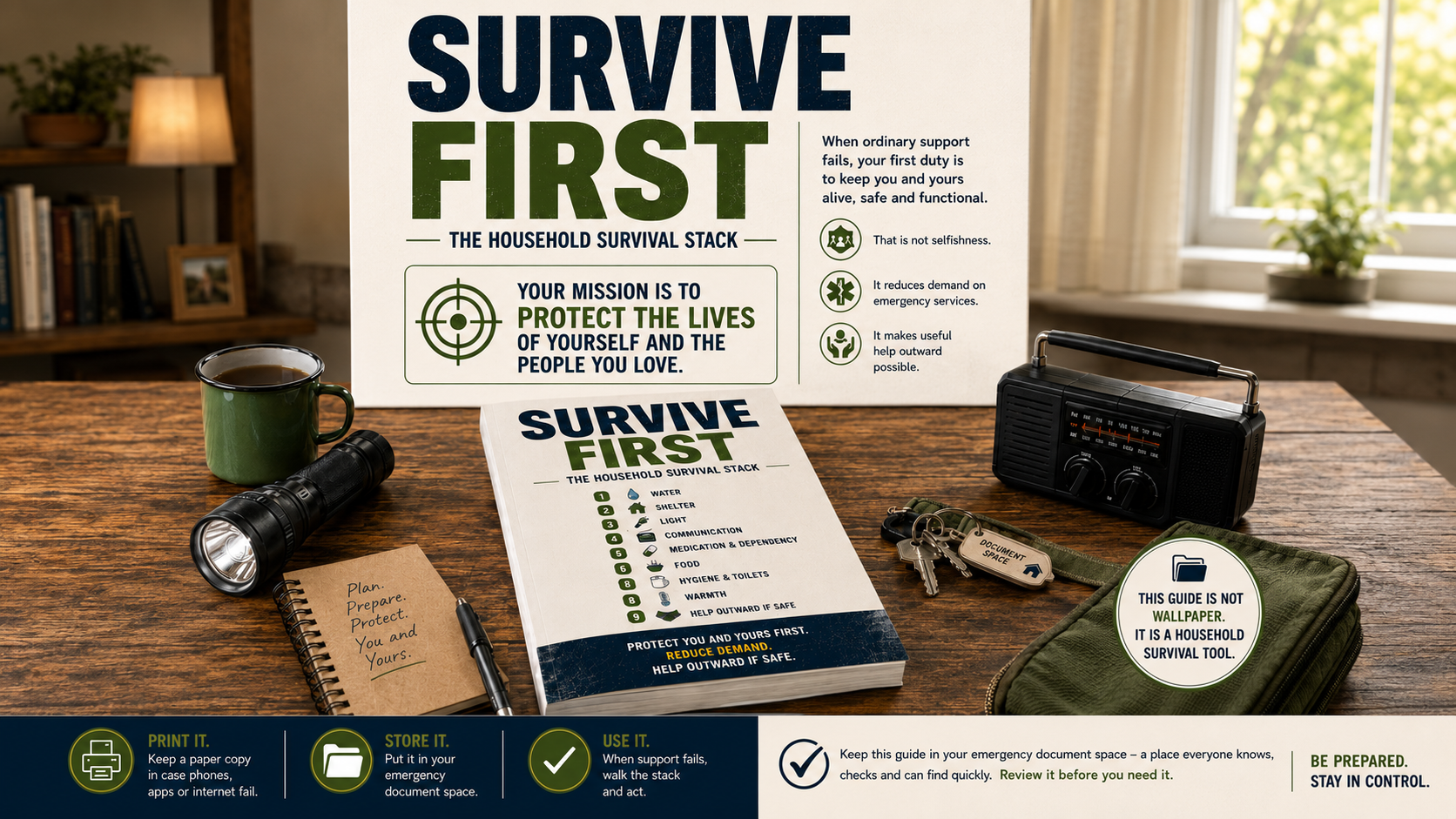
Survive First: Where National Resilience Reaches the Household
It was striking that, while appearing before the Defence Committee to discuss military readiness and the Defence Investment Plan, Lord Robertson and General Sir Richard Barrons eventually found themselves talking about ordinary citizens, local communities and what people might need in their own homes. (House of Commons Defence Committee, 2026, Q44–46)
They had not wandered away from defence. They had reached its foundation.
Barrons’ point was that a country which can absorb disruption, continue functioning and sustain the will to resist is much harder to defeat. That means protecting far more than military capability. It means keeping food, water, communications and the ordinary life of the country working under pressure, most of which does not belong to the Ministry of Defence. (House of Commons Defence Committee, 2026, Q44–46)
Then, as the discussion turned towards the responsibilities of government, Robertson added four important words.
“But every citizen as well.”
That leaves a much bigger question.
If whole-of-society resilience includes every citizen, what exactly are ordinary people being prepared to do?
For years, the phrase has largely described institutions talking to other institutions. Government departments, local authorities, businesses, voluntary organisations and emergency services are all brought into the room, while the citizen tends to appear at the end as somebody to be informed, advised or reassured.
Meanwhile the public are usually told to visit the website, download the app, prepare a kit and wait for instructions.
We describe them as partners but still treat them as an audience.
That is not because British people are unwilling to help or incapable of doing so. We have organised our formal response systems in a way that has taught people to wait, and we cannot now move straight from that position to a Nordic model of civic responsibility and expect the public to understand a role they have never properly been given.
Finland and Sweden enter this conversation from a different place. Preparedness there already sits within a wider understanding of citizenship, national responsibility and the relationship between the individual and the state. Their public information does not have to introduce the idea that citizens may have a role in a national emergency because that ground has already been prepared. (House of Lords National Resilience Committee, 2026, Q18)
My own work has drawn on colleagues with direct knowledge of the Finnish approach, including examples of citizen training, and on Sweden’s public preparedness material, a copy of which was given to the House of Lords National Resilience Committee. I have also examined examples from elsewhere in Europe and beyond. (House of Lords National Resilience Committee, 2026, Q18; Swedish Civil Defence and Resilience Agency, 2024)
What becomes clear is that Britain cannot simply copy the final product and ignore the civic foundations beneath it. We need to begin somewhere more immediate and more human. What happens to you and the people you care about when the systems supporting ordinary life stop working? That is where Survive First begins.
The home is not where resilience ends. It is where it starts.
The Household Survival Stack has therefore been kept deliberately simple. It is not built around what people should buy. It is built around what a household must continue to do when normal systems begin to fail. It asks what happens to the ordinary functions on which a household depends when the systems supporting them begin to disappear.
These are not simply items on an emergency shopping list. They are the functions that allow a household to remain alive, make decisions and preserve enough stability to avoid becoming immediately helpless. A torch may provide light, but light is the function. Bottled water may help, but drinking, cooking, taking medicine and maintaining basic hygiene are the reasons it matters.
Preparedness may involve equipment. Survivability depends on understanding what that equipment is there to preserve.
This is where national language meets human reality. Government may speak about water resilience, telecommunications, food security or national endurance. The household experiences an empty tap, a dead telephone, a cold room, a missing prescription or a card payment that no longer works.
The Stack translates one into the other.
None of this is about abandoning people to survive alone or allowing the state to step away from responsibilities only it can fulfil. Citizens cannot secure the national grid, protect water infrastructure or keep national food and communications systems running.
But government cannot be present in every home when disruption begins.
A household already overwhelmed by thirst, cold, missing medicine or confusion is another household waiting to be rescued. A household that can preserve enough function for a little longer has a better chance of thinking clearly, connecting with others and becoming part of the response.
That is what Lord Robertson’s “every citizen as well” begins to mean in practice.
Every national resilience plan eventually reaches someone’s front door. Survive First begins on the other side of it.
References
House of Commons Defence Committee (2026) One-off Session on the Defence Investment Plan: oral evidence, 7 July 2026, HC 530. Available at: https://committees.parliament.uk/oralevidence/17906/pdf/ (Accessed: 14 July 2026).
House of Lords National Resilience Committee (2026) Corrected oral evidence: Nordic ambassadors, 19 March 2026, Questions 18–30. Available at: https://committees.parliament.uk/oralevidence/17386/html/ (Accessed: 14 July 2026).
Swedish Civil Defence and Resilience Agency (2024) In case of crisis or war. Available at: https://www.mcf.se/en/advice-for-individuals/the-brochure-in-case-of-crisis-or-war/download-and-order-the-brochure-in-case-of-crisis-or-war/ (Accessed: 14 July 2026).

