
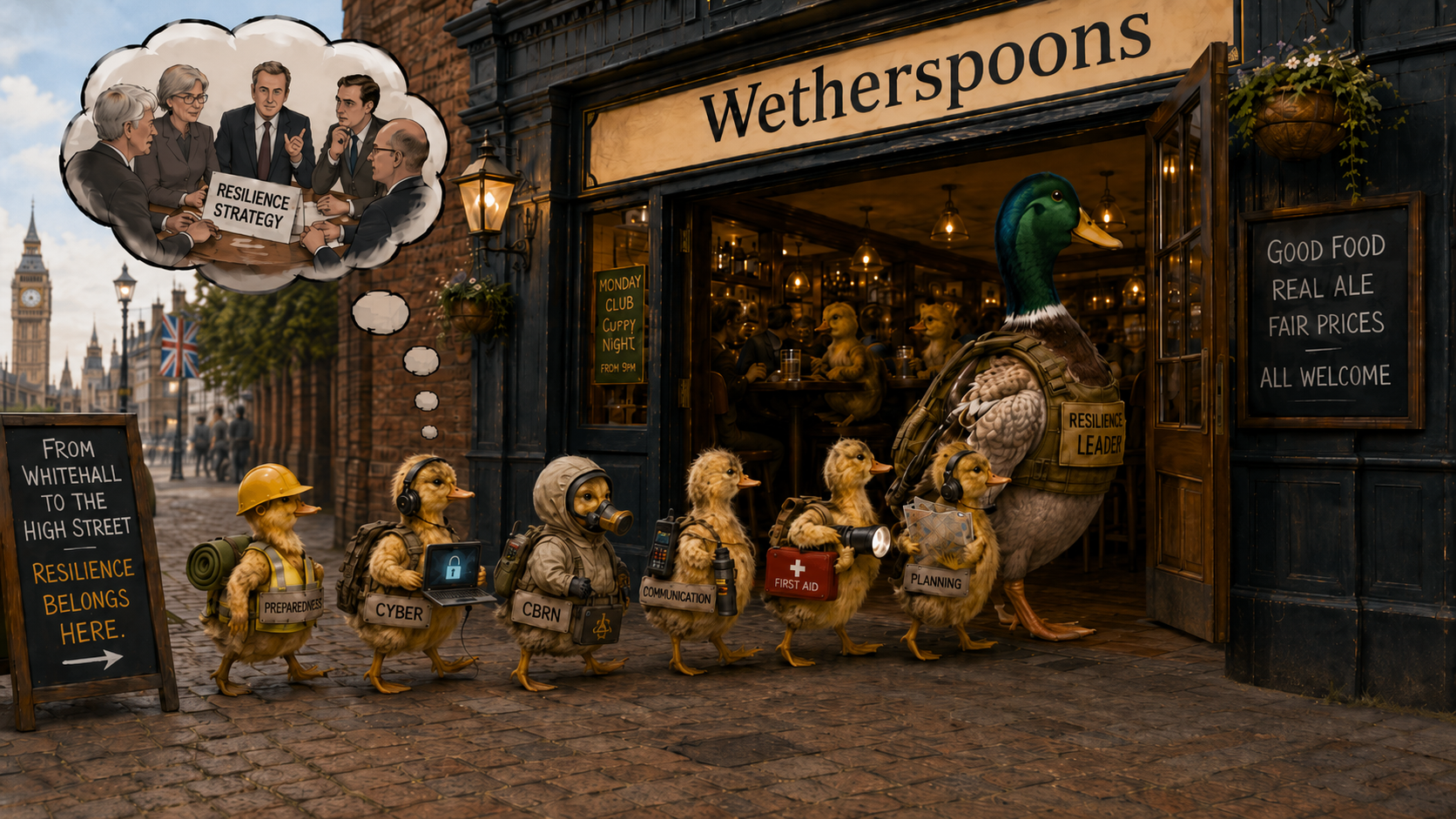
When A Resilience Debate Doesn’t Reach Ordinary Life – It’s Just A Debate!
Most people in Britain do not even know there is a House of Lords inquiry taking place into national resilience.
That should trouble us more than it does. Not because the committee has failed to identify the broad problem. It has not. The committee already knows the threats are real, preparedness has been neglected, and the country is more fragile than it ought to be. The point of an inquiry like this is not to keep restating the diagnosis. It is to test answers.
That is why the public’s ignorance matters.
There is an old question about whether, if a tree falls in a forest and no one hears it, did it really fall? The modern Westminster version might be this: if a national inquiry into resilience takes place and the public it ultimately depends on remain blissfully unaware of it, what exactly has been achieved beyond another elite conversation? That is not a side issue about communications. It goes to the heart of whether the process is doing what it was meant to do.
I do not say that because I think the committee lacks intelligence. It clearly has it in abundance. Nor do I say it because the risks are unreal. They are plainly manifold. The problem is not the committee. A committee can only report on what it sees, hears, and reads, which is precisely why the process around it matters so much.
The deeper I looked, the more it seemed that an inquiry set up to test practical alternatives was in danger of hearing different versions of much the same establishment answer, while the public whose role is supposedly central to any whole-of-society approach remained almost entirely outside the conversation.
That is what compelled me to write this. Not grievance. Not theatre. Not because I think every witness is wrong. It was the cumulative shape of the thing that became too hard to ignore.
On paper, the inquiry looks broad. There are now well over a hundred written submissions, which sounds impressive and allows everyone involved to say, perfectly truthfully, that the committee has heard a wide range of voices. The difficulty is that volume is not the same thing as breadth. Once you start looking more closely, a pattern appears.
- A large number of submissions sit comfortably inside the same broad establishment grammar of resilience: stronger centre, more coordination, more machinery, more legislation, more public messaging, more formal architecture.
- Others are really pleas for more support, more recognition, or more money to help existing organisations continue doing what they already do.
- Some are, in truth, polished adverts for a capability, a framework, a consultancy, or a niche offer.
- A few speak mainly for a particular constituency rather than offering a broadly transferable answer.
What is much rarer is a submission that asks the harder question plainly enough for an ordinary person to recognise it: what would actually make my family, my street, my town more able to cope when systems are delayed, degraded, or simply not there?
That distinction matters more than people think. The curators of the inquiry can say it has received a great deal of serious evidence and still not have heard many genuinely practical answers. It can point to weight of opinion and still be looking at repeated convergence rather than real diversity of thought. That may satisfy Westminster. It does not satisfy ordinary life.
This is why the Westminster-to-Wetherspoons test matters. By that I mean a very simple thing: can resilience travel from government, Parliament, think tanks, expert panels and the policy circuit into ordinary everyday life, where the country in all its variety actually lives? Because if it cannot, then what we are really looking at is not national resilience at all, but elite resilience discourse.
The customer in Wetherspoons is not some narrow type. It is a shorthand for everyday Britain in all its mess and variety: families, workers, pensioners, friends, people having breakfast, lunch, a coffee, a meal, or a pint. People who do not follow committee hearings and do not speak in policy language.
What they care about is whether any of this would mean something in the first hour, the first night, or the first week when ordinary life stops working. They care whether their family can cope if the power is out, the phones are down, the water is interrupted, the roads are blocked, or help is delayed. They care whether anyone, anywhere, has stopped talking long enough to build something useful.
This is why the Nordic session mattered so much. The round of applause the committee gave the ambassadors was genuine. You could feel it. They were not applauding jargon, theatre, or a clever presentation deck. They were applauding people who spoke with clarity, purpose, and the calm assurance of societies that settled this question a long time ago.
But I also think something important was missed.
What the Nordics were really saying was not, “Here is an interesting model you may wish to consider.” It was closer to, “Why would you not just get on with it?” You start. You build. You repeat. You embed. You do not wait for the perfect framework, the perfect slogan, or the perfect set of permissions from the centre. Preparedness is not a performance. It is a habit. That was the deeper lesson. The committee clearly recognised the seriousness of what it was hearing.
I am less sure the process knows what to do with it.
Because the process keeps pulling back towards the same family of responses. More structure. More coordination. More machinery. More formal architecture. All of which may have their place, but none of which should be confused with the thing itself. Resilience is not proved by having a plan, publishing a booklet, launching an app, or creating another panel, another reporting line, or another set of recommendations.
Those things only become meaningful if the human foundations beneath them already exist. If ordinary people do not have the confidence, judgement, practical ability, and social instinct to survive, adapt, and help each other when systems are delayed, degraded, or overwhelmed, then much of what sits above that is simply decorative.
That, to my mind, is the fault line running through this inquiry. On one side sits an establishment grammar that is serious, respectable, and often correct in diagnosis, but still pulled towards systems, structures, and managed architecture from above. On the other sits a smaller body of thinking, including some of the strongest practical submissions, that begins from the human edge: what ordinary people, localities, and communities can actually do when systems are late, stretched, or absent.
The issue is not whether the National Preparedness Commission exists or seeks to shape the terms of debate. That is what respected institutions do. Nor is it that the committee is somehow complicit in narrowing the field. It can only work with what it is given. The issue is that once a respected establishment grammar becomes sufficiently dominant, repeated reinforcement begins to look like considered examination.
There have been moments in the inquiry when you can sense that some members already see the problem. The Nordic evidence brought that out clearly. So did the flashes from Baroness Coussins, Baroness Curran, Lord Farmer, and Lord Peach. The difficulty is not that the committee cannot recognise a practical answer when it catches sight of one. It is that those managing the process, keep steering it back towards variations of previously established ground.
And this is why it matters.
A serious inquiry into national resilience was meant to do more than confirm that the country faces real dangers. It was meant to test how resilience is actually built, how a whole-of-society approach is made real, and what practical gaps need to be filled. If the process instead keeps narrowing the range of answers that can be properly heard, then the danger is not simply that time and money are wasted. It is that the country is left with the impression that preparedness is being discussed at length while very little is being built where it matters most.
In the end, your average “Spoons” customer will judge this much more simply than Westminster will. They will not ask how many submissions were received, how many expert witnesses appeared, or how carefully the language was refined. They will ask whether anything useful came of it.
And if what they see is another respectable conversation happening out of sight, then the verdict will be a simple one.
A duck is a duck. And a resilience debate that never travels from Westminster to Wetherspoons is still a debate, not a prepared country.

